
E-PROPS TEST FACILITIES
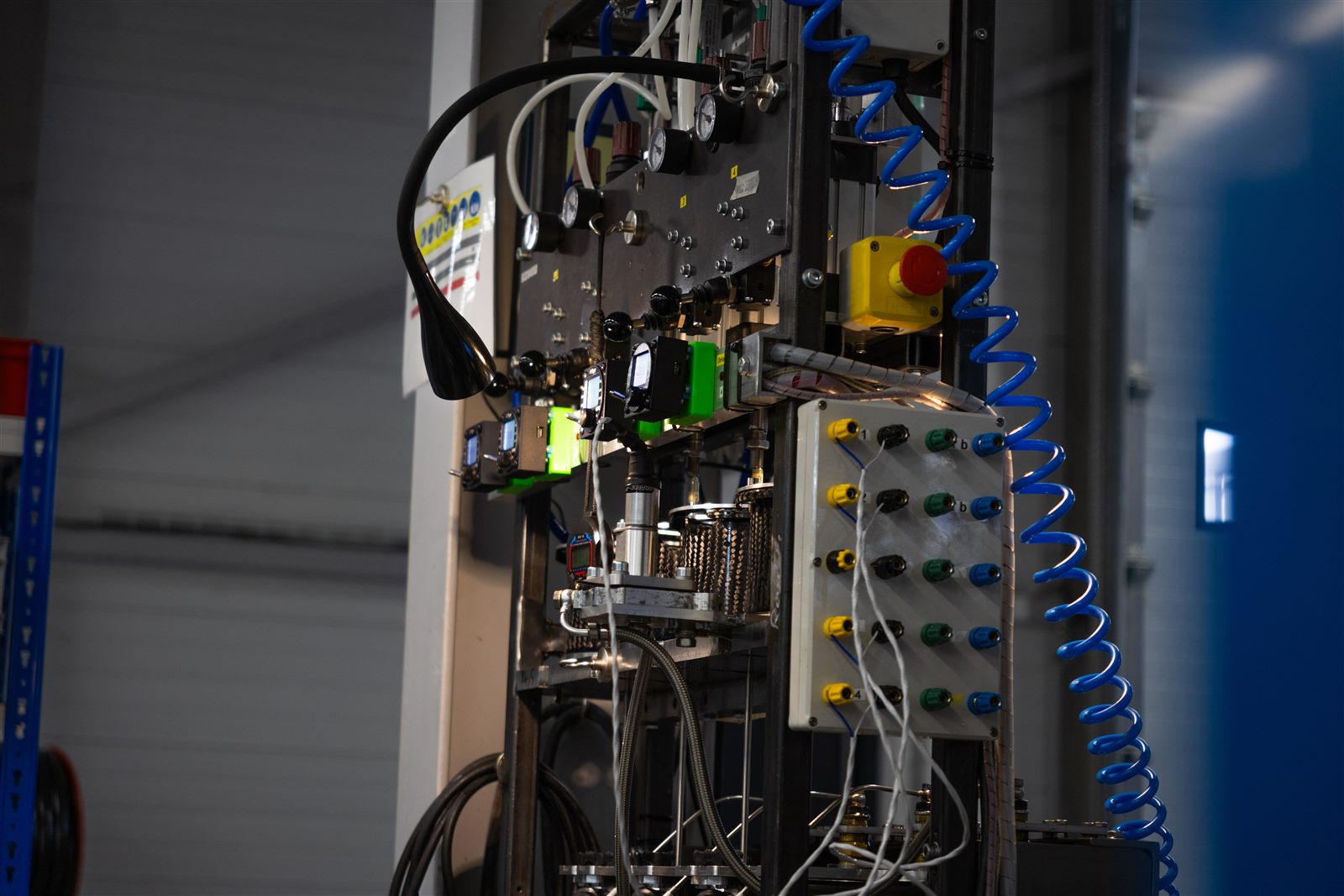
Like most propeller makers, we test our products to meet aviation standards. But at E-Props, we’ve always wanted to go further than the minimum — and push our propellers toward constant improvement, and even greater safety.
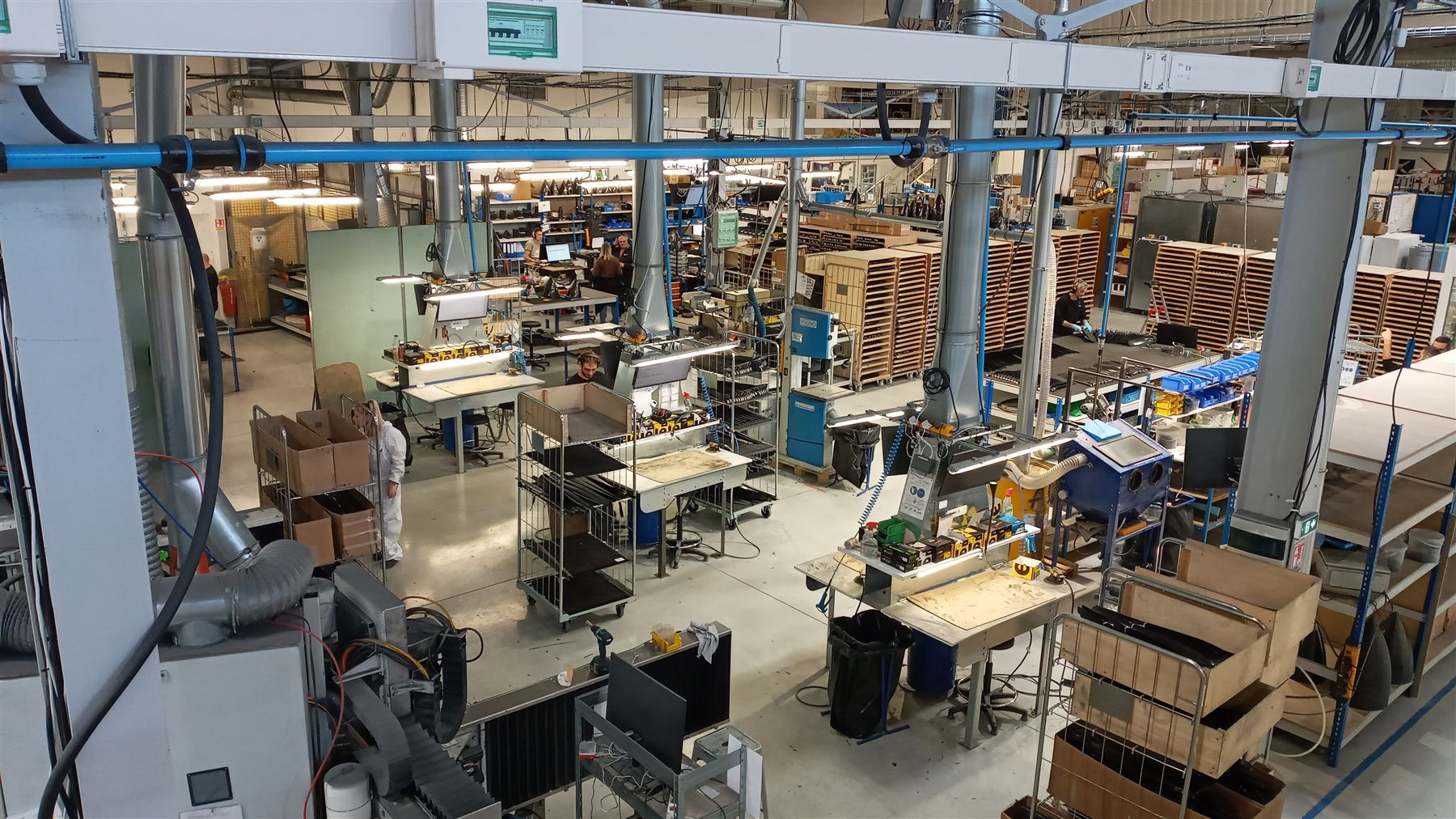
To get there, our Research Department has built up a set of test facilities you won’t usually find at a light-aviation propeller manufacturer: laser-scanning inspection, instrumented ground benches for thrust, fatigue, vibration and bird-strike impact, an in-flight data-acquisition system, and our own in-house design software. Add to that our own test aircraft, flown by our dedicated test pilot from Sisteron–Vaumeilh airfield (LFNS) — and you get a testing capability that’s rare in our industry.
Here’s a tour of how we put our propellers to the test.
Terminator — Laser-Scanning Inspection
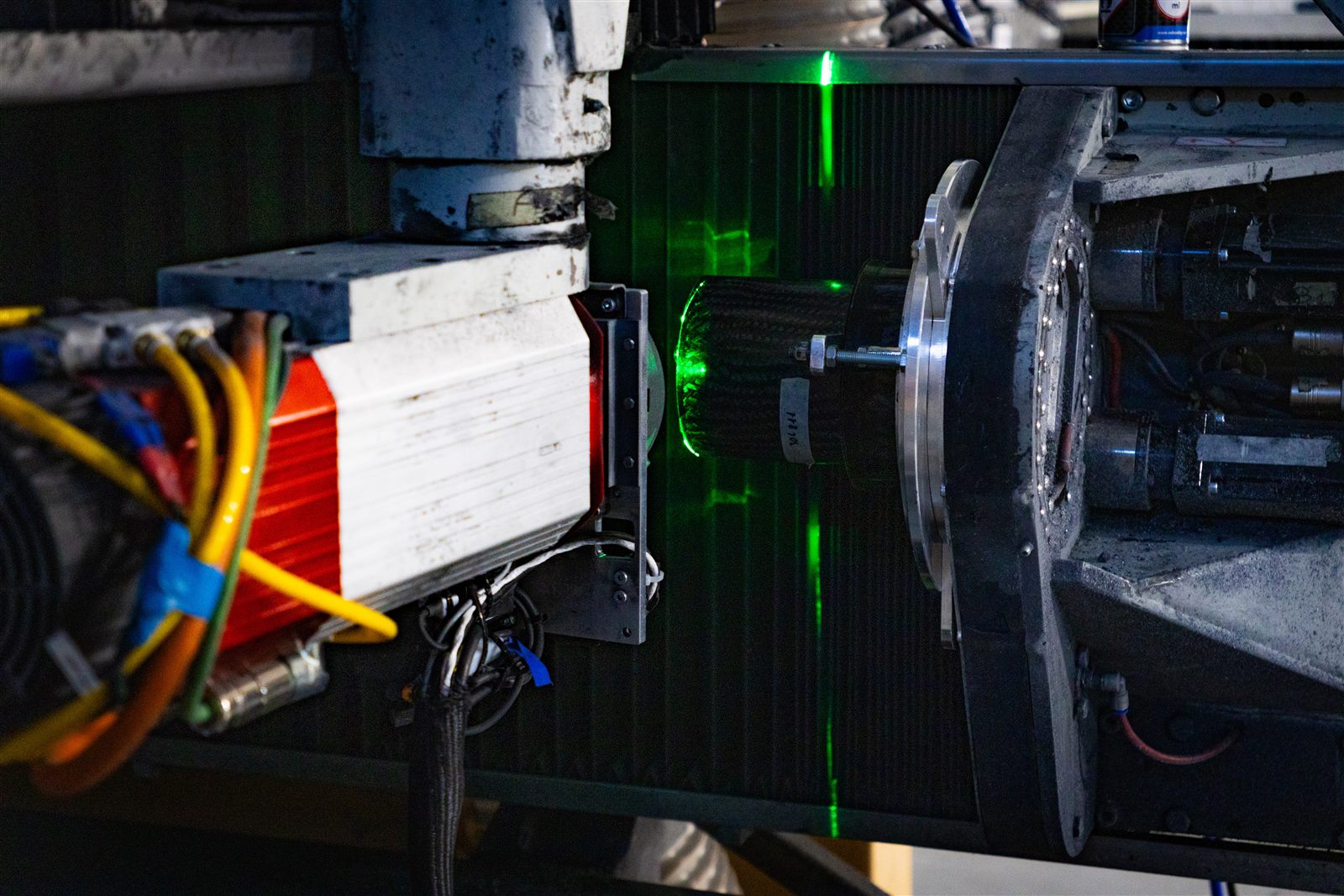
Every blade and component is checked dimensionally with our 2 Terminator laser-scanning systems: high-precision lasers measure the actual surface geometry of the part and compare it, point by point, with its digital reference model. This 3D control is applied systematically — before and after mechanical testing — to confirm that every propeller matches its design geometry, with no dimensional drift after fatigue, vibration or impact testing.
Traction (Thrust) Test Bench
A ground bench fitted with instrumentation and a traction (thrust) measurement system, built around a 40-tonne hydraulic cylinder. It verifies the static thrust delivered by a propeller/engine combination and validates our design calculations before any flight testing begins.
Fatigue Test Bench
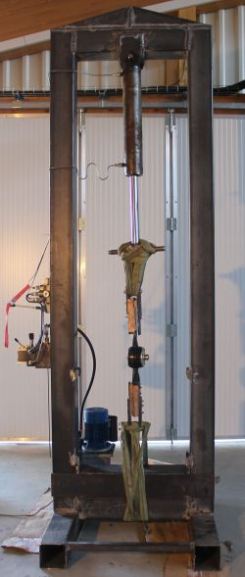
This bench stresses a blade in alternating bending to reproduce the torque delivered by the engine. It’s how we establish the real Mean Time Between Overhaul (MTBO) of a propeller — not just a calculated estimate.
RESONATOR — Torsional Vibration Test Bench
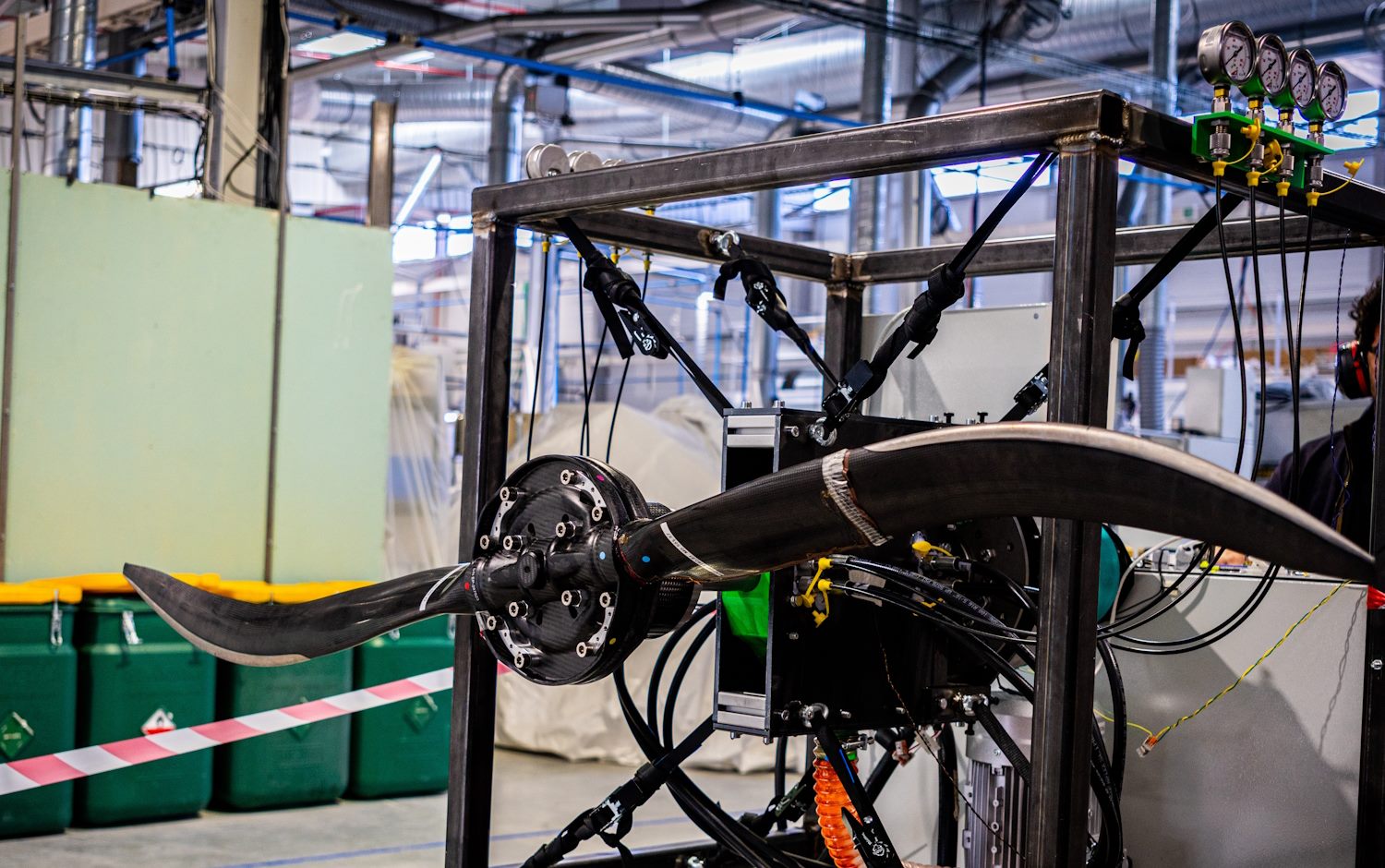
For propellers designed for direct-drive engines, we built a dedicated vibration bench able to reproduce, with high fidelity, the vibratory loads generated by aeronautical piston engines — especially large 4- and 6-cylinder units.
The bench combines four elements: a torsion bar, a flywheel, an electric servo-motor, and a high-precision digital encoder. Together, they reproduce the vibratory component of engine torque under severe conditions — up to three times the levels measured in real operation. That lets us validate the fatigue resistance of a propeller under torsional vibration, and determine its service life in line with EASA CS-P §370 requirements. Our current goal for the ASCALON range: an unlimited service life.
Why does this matter? Engine torque vibrations are high-frequency torque exchanges between the engine and the propeller — generally imperceptible to the pilot. You won’t feel them in flight, but they have a major impact on internal stresses and component ageing. It’s exactly this phenomenon that explains the restricted RPM ranges found on certain engine/propeller combinations: within these ranges, resonance can strongly amplify mechanical loads. (More on this below, in our Lycoming O-360 case study.)
Chicken Gun — Bird-Strike Impact Test Bench
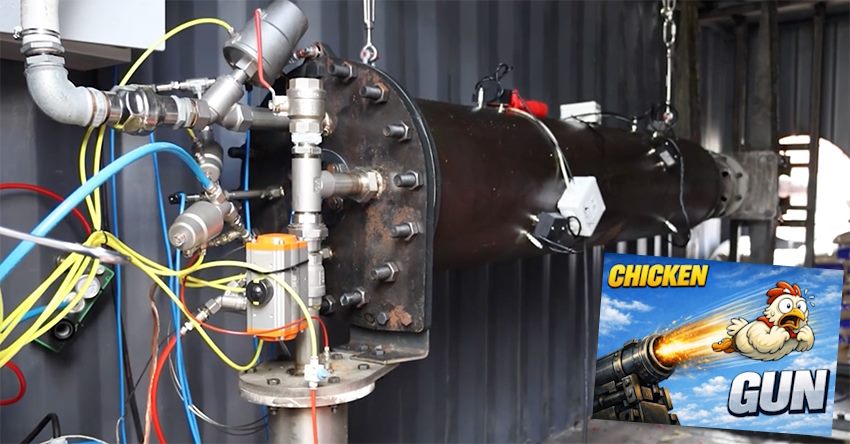
Bird impacts are among the most demanding events a propeller can encounter in service. To assess blade robustness under such conditions, the aerospace industry uses a “chicken gun” to simulate a controlled impact with a bird-sized projectile at representative velocity.
We designed and built this bird-strike bench ourselves — it’s part of the development and validation campaign for our ASCALON range, dedicated to direct-drive engines and currently undergoing EASA CS-P and FAA 14 CFR Part 35 certification. Having this capability in-house gives us a unique level of autonomy and confidence in the robustness of our propellers.
SHEEVA — High-Pressure Hydraulic Test Bench
The SHEEVA bench tests the governor, regulator and calculator assemblies of our GLORIEUSE variable-pitch propeller range. It simulates real flight conditions hydraulically, so every one of these components is individually validated before delivery.
Our Aircraft Fleet — and Our Test Pilot
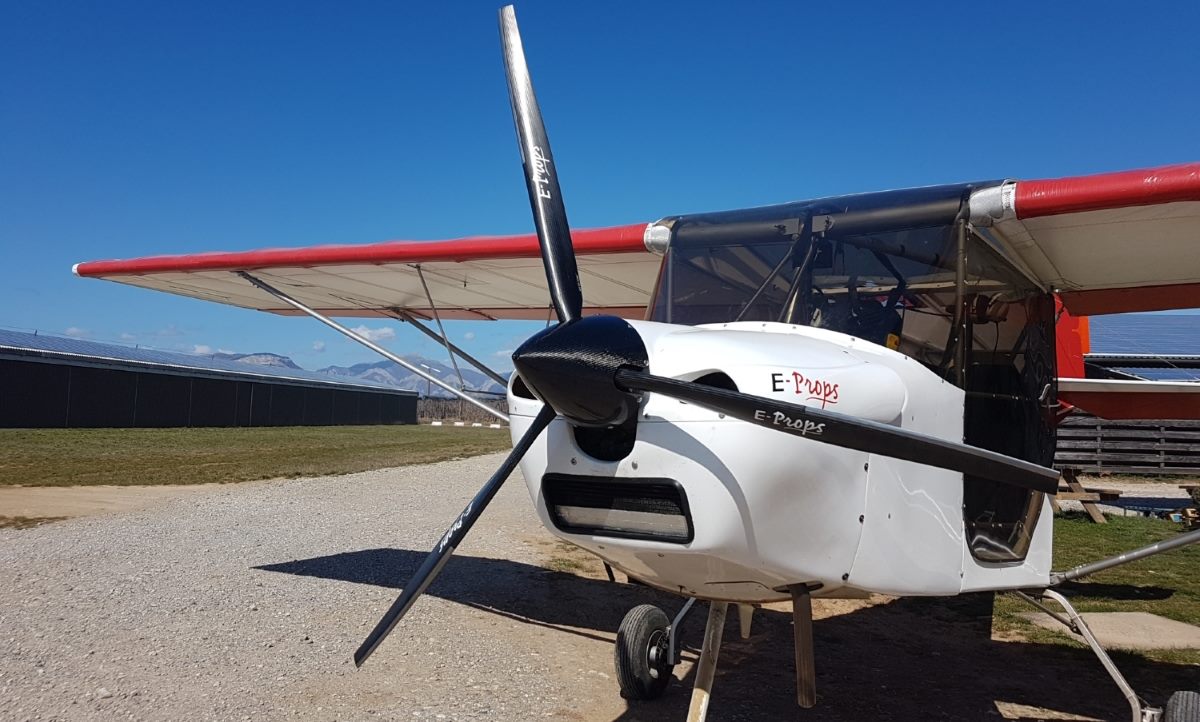
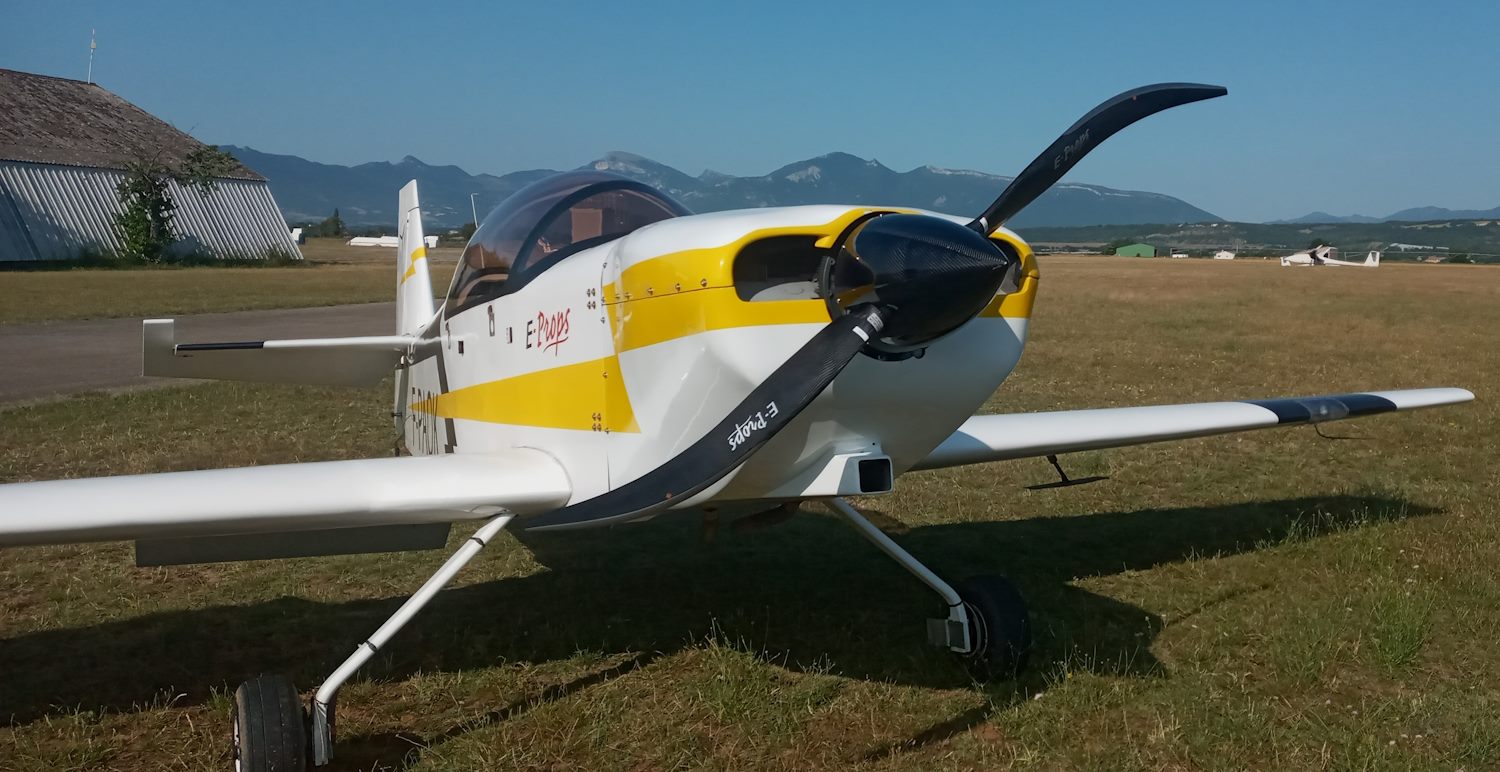
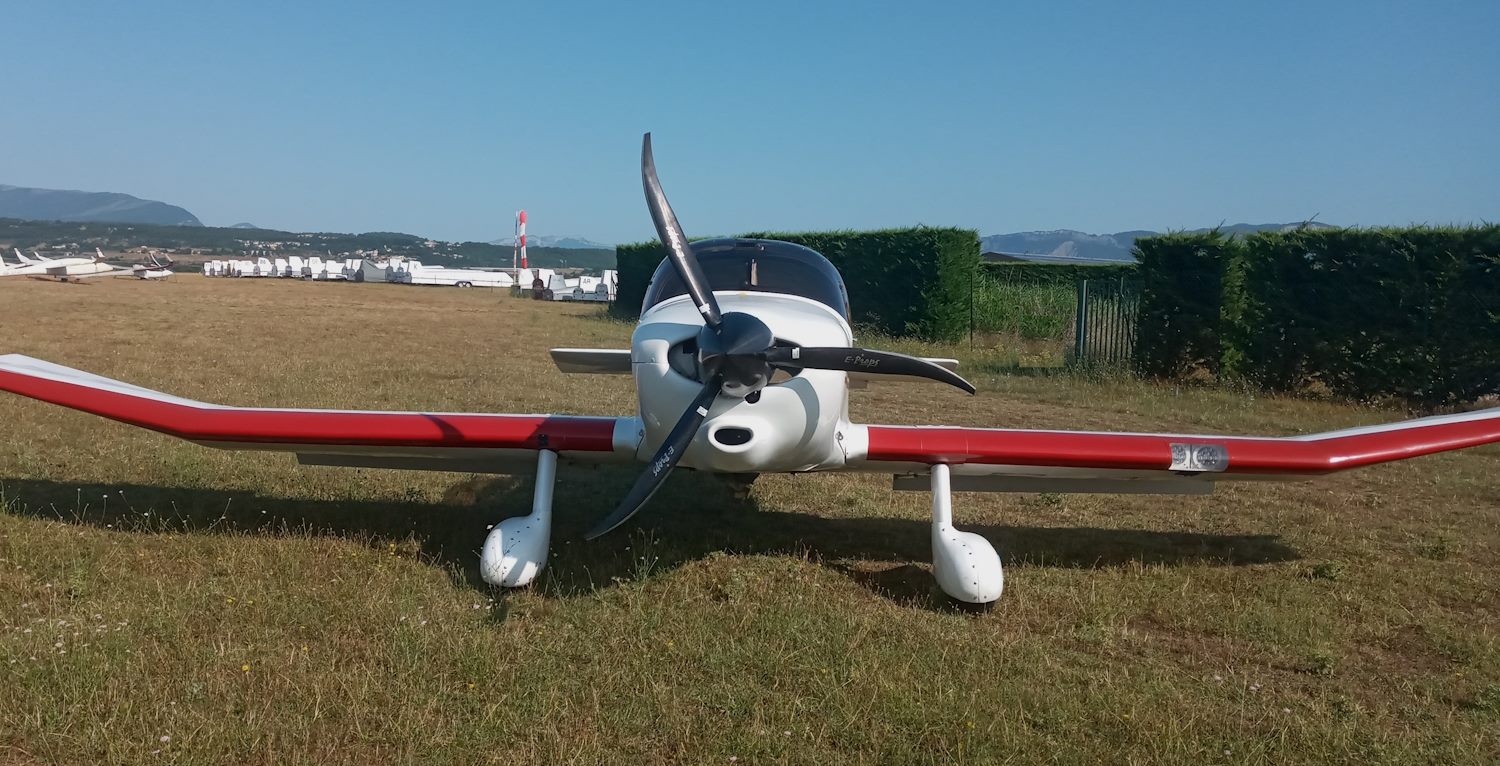
Our own aircraft let us run flight-test campaigns on every propeller model and prototype, flown from Sisteron–Vaumeilh airfield (LFNS).
| Aircraft | Role | Seats | Engine |
|---|---|---|---|
| SKYRANGER | Ultralight aircraft, low-speed range (30–190 km/h) | 2 | Rotax 912S — 100 hp |
| PENA Bilouis | Aerobatic flight test, VNE 370 km/h – 200 kt | 2 | Lycoming O-360 — 180 hp |
| JODEL DR1054 | Cruise flight test, VNE 270 km/h – 146 kt | 4 | Lycoming O-320 — 150 hp |
The ultralight SKYRANGER, acquired in 2015, was our very first test aircraft. Its simple tube-and-fabric structure makes it easy to fit measurement equipment — a boom under the wing for airspeed and angle-of-attack readings, a cockpit packed with instruments and cameras — and it covers a useful low-speed range from 30 to 190 km/h.
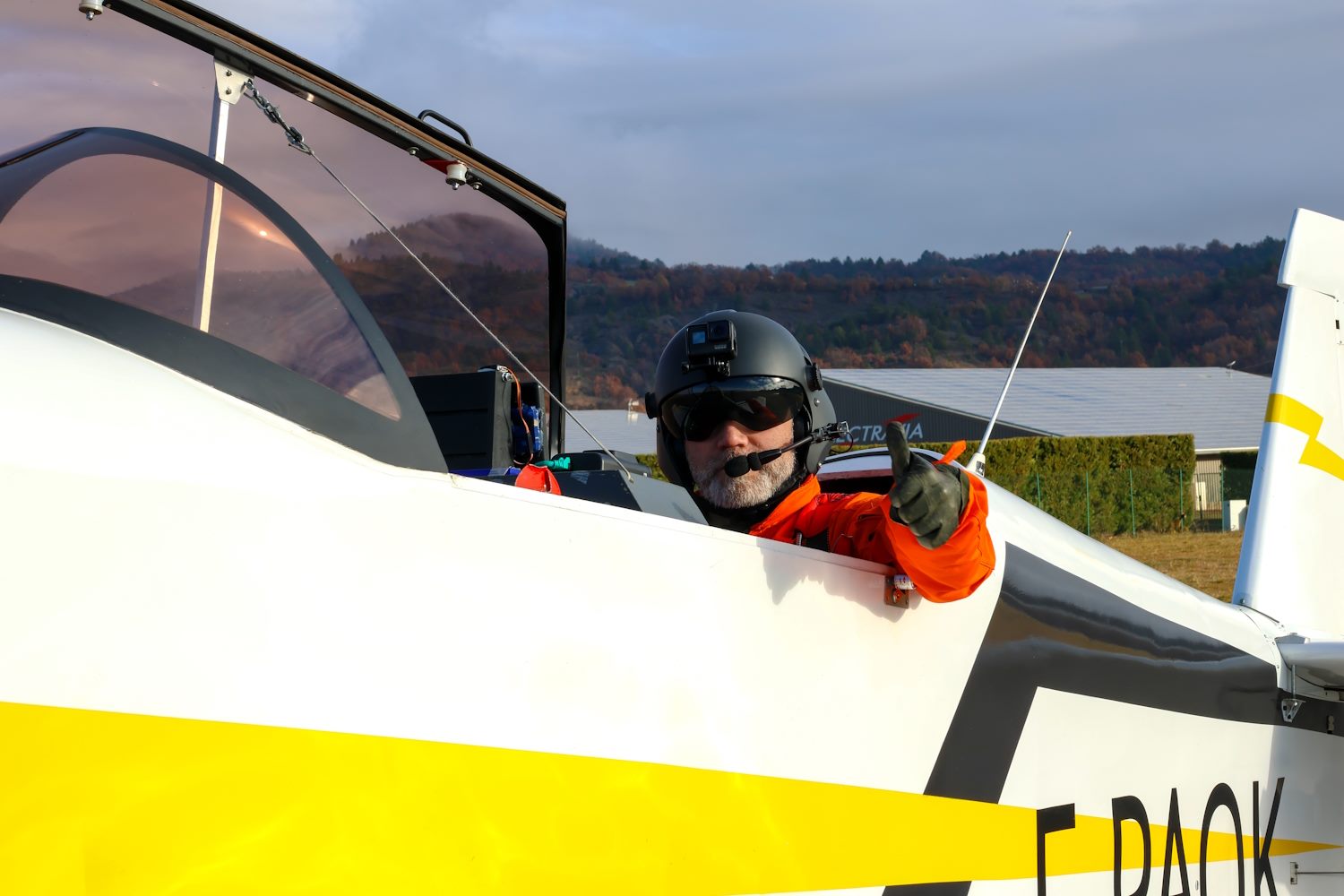
All our flight and ground test campaigns are flown by Samuel “Samy” Dupland, our dedicated test pilot since 2020 — with more than 5,000 flight hours of experience.
ELIAS — In-Flight Data Acquisition & Instrumentation
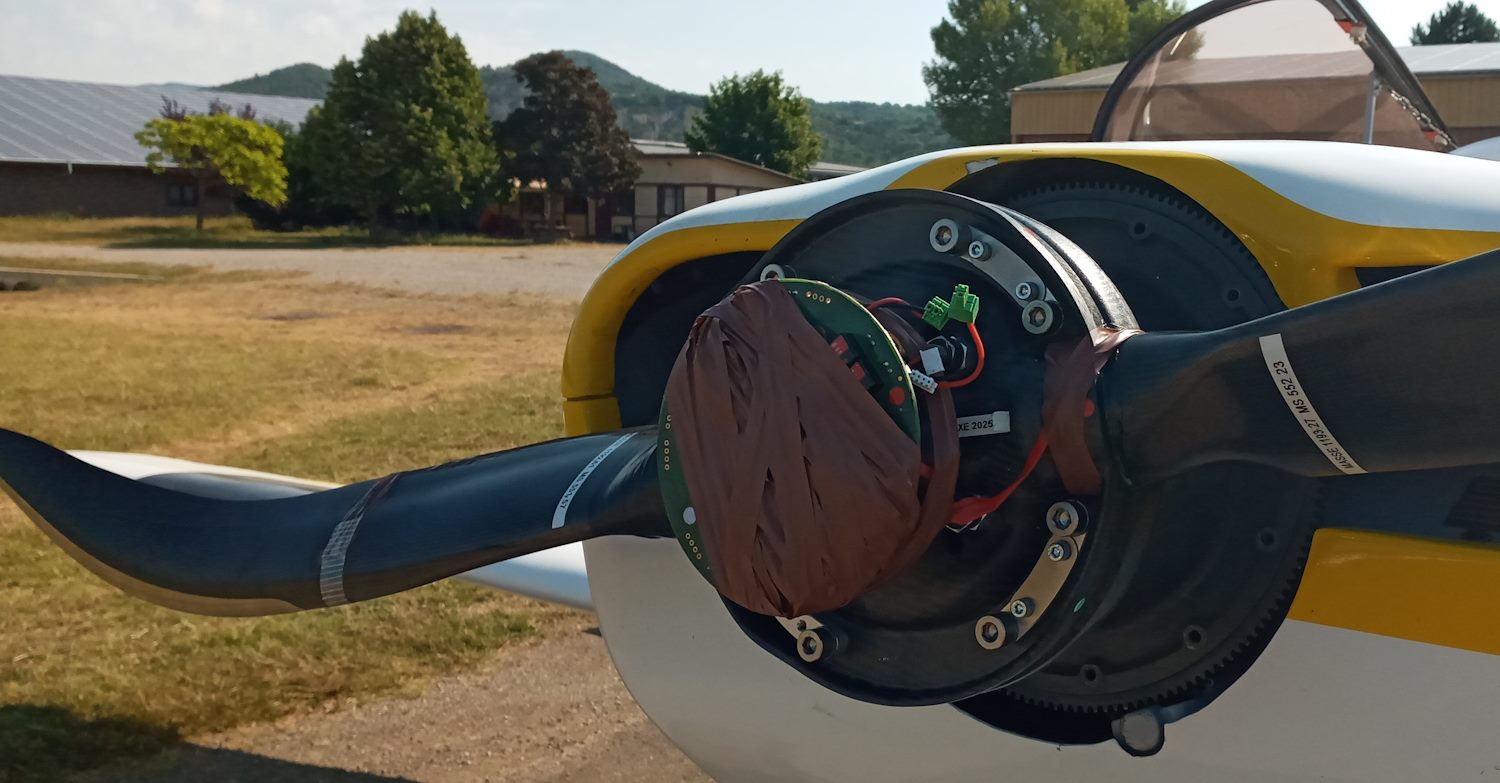
ELIAS is our onboard Data Acquisition System (DAU) — designed and manufactured entirely in-house. It was originally built to measure propeller/engine vibration and blade strain, and now also covers a complete flight-performance measurement chain. At every moment of a flight or ground run, it records:
- propeller thrust and propeller torque,
- temperatures, static and dynamic pressures,
- engine RPM, engine temperature and manifold pressure,
- angle of attack and angle of sideslip,
- vibratory loads and blade strain at the propeller hub and blade roots.
A complex set of sensors, an electronic unit and strain gauges are integrated into the propeller hub, the blade roots, and other key locations on the airframe or engine. Thousands of measurements are transmitted in real time — by Wi-Fi, and 3G during flight campaigns — to an onboard computer and a cockpit display that lets the pilot fine-tune the flight profile on the spot.
The results are far more precise and realistic than wind-tunnel testing, and come in a fraction of the time: gathering the same volume of data in a wind tunnel would take years of test campaigns. Flight data is then processed in our LUKY software.
ELIAS for ASCALON customers: a streamlined version of ELIAS ships with every ASCALON propeller, built into a spacer between the engine flange and the propeller hub. In a few minutes of static ground running, it lets owners run a personalized vibration survey of their own engine/propeller installation — a service you’ll rarely find elsewhere in light aviation. Every engine has its own vibration signature, and direct-drive engines have no gearbox to damp crankshaft torsional vibration. This individual check confirms that resonance conditions on your specific installation fall well outside your normal operating RPM range — very much in the spirit of the historical Hartzell vibration campaigns that gave us the restricted (yellow/red arc) RPM ranges seen on many certificated aircraft today.
LUKY — Design and Optimization Software
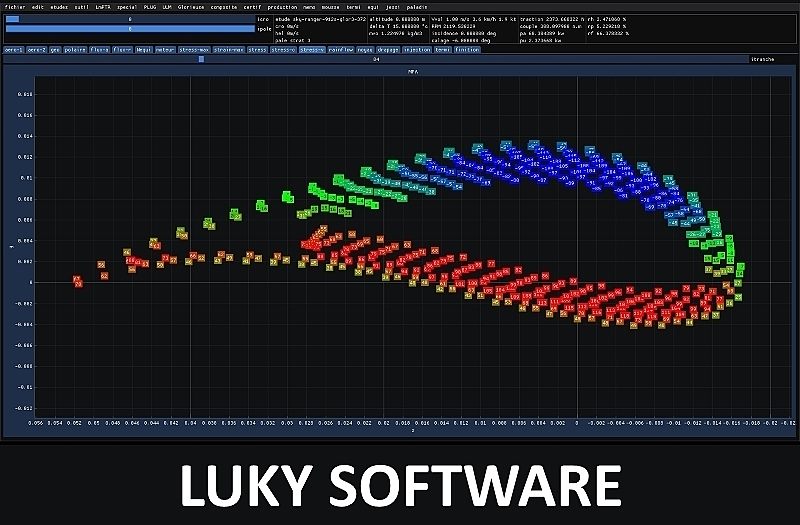
LUKY is our in-house propeller design and optimization software. It models the coupled torsional dynamics of engine and propeller to predict vibratory torque transmission across the whole operating speed range, then runs evolutionary optimization algorithms to explore blade geometry, mass distribution and aerodynamic parameters — all aimed at minimizing torsional excitation while keeping aerodynamic performance intact.
LUKY also predicts blade-tip motion under resonance, so we can spot and mitigate potential resonances early in the design phase — rather than discovering them after the fact. It’s also the software where all of our ELIAS flight data ultimately gets analyzed.
Case Study: Torsional Vibration on a Lycoming O-360
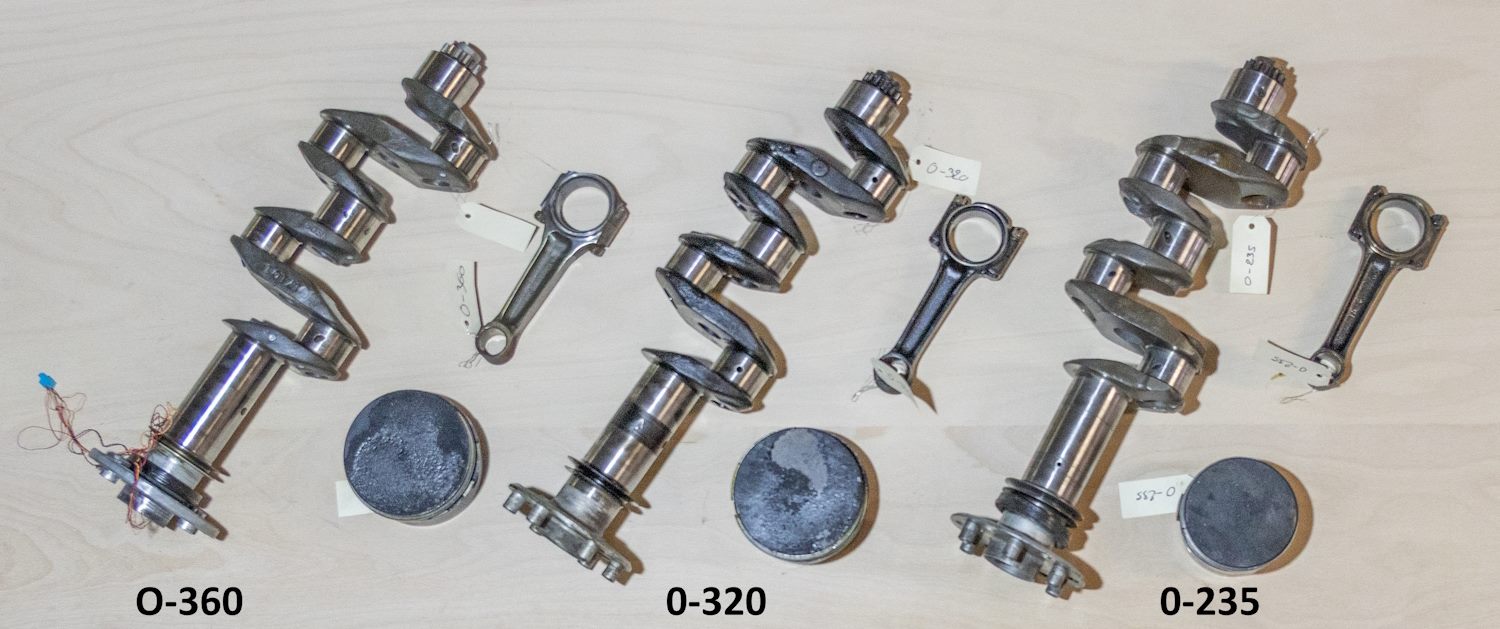
To show how all these test means come together in practice, we instrumented a Lycoming O-360-A1D engine (hollow crankshaft, internal strain gauges) with the ELIAS system — 16 channels, 6.5 kHz per channel, GPS-synchronized, Wi-Fi + 3G transmission — and compared four propellers, on the ground and in flight.
| Propeller | Resonance | Remarks |
|---|---|---|
| Aluminium (Sensenich, 2-blade) | ~2350 RPM | Strong resonance, within the manufacturer’s restricted RPM range |
| Wood (Hoffmann, 2-blade) | ~2225 RPM | Moderate torque level; range not currently flagged as restricted |
| Carbon, 5-blade (DUC FLAIR-2) | ~2625 RPM | Ground test only — propeller decertified by EASA; included for research purposes |
| Carbon, 3-blade (E-Props A42) | ~2250 RPM | Very slight resonance, lowest torque levels of the four propellers |
Vibratory torque was extracted using a rainflow cycle-counting method to build a conservative envelope of high-frequency loading versus engine RPM. The result: our three-blade carbon propeller, designed with the LUKY dynamic engine/propeller model and evolutionary optimization, showed markedly lower torsional excitation than the other three propellers — real flight and ground data demonstrating the value of designing the propeller and engine as a single dynamic system, rather than tuning the propeller as an afterthought.
Reference: J. Buiatti, Experimental Torsional Vibration Analysis of Different Propellers on a Lycoming O-360 Engine, E-Props, January 2026.
Built for Certification
All the test means described above support compliance with the applicable propeller airworthiness requirements — EASA CS-P (including the fatigue/vibration requirements of §370), ASTM standards, and FAA requirements, depending on the propeller model and market. You’ll find links to the corresponding test reports in the comments section of each propeller in our catalog, and plenty of test videos on our YouTube channel.
Want to see these test benches in action? Follow us on social media 😊


Post Comment
You must be logged in to post a comment.