
Propulsive Efficiency: The Physical Limit Every Propeller Must Respect
Why does a small-diameter propeller always feel disappointing on a slow aircraft? Why do more blades sometimes help — but never enough to fully compensate for a diameter that’s too small? The answer isn’t in the carbon layup or the airfoil selection. It’s in a limit set by basic physics, long before any design work begins.
Understanding this limit is the starting point of every propeller E-Props designs — so it’s worth explaining simply, without the equations getting in the way of the idea.
Thrust is a reaction, not magic
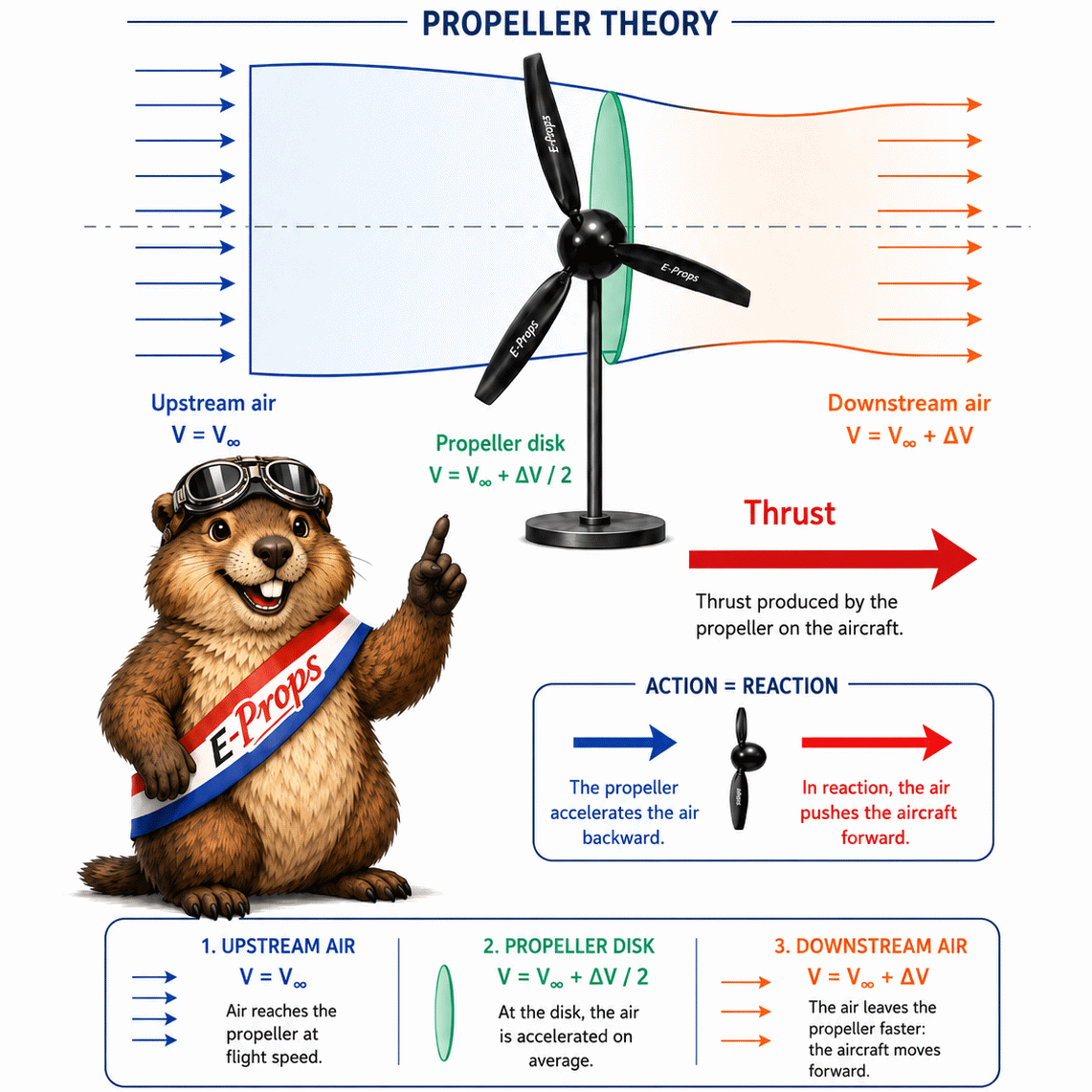
A propeller doesn’t “grab” the aircraft and pull it forward. It pushes on the air, and the air pushes back — Newton’s third law, action and reaction. To produce a forward force on the aircraft, the propeller must produce a backward force on the air passing through the blades’ swept disc.
That air isn’t a fixed mass — it’s a continuous mass airflow, equal to the disc area times the air speed times the air density. The blades, shaped like small wings, generate lift forces on this airflow and change its speed. That speed change is the entire mechanism of thrust.
How much faster does the air go?
The speed increase between the air ahead of the propeller and the air behind it depends directly on the thrust produced and on how much air mass is being accelerated:
**ΔV = Thrust / mass airflow**
Half of this speed increase happens *before* the disc, and half *after* — the air is already accelerating as it approaches the propeller, and keeps accelerating slightly as it leaves.
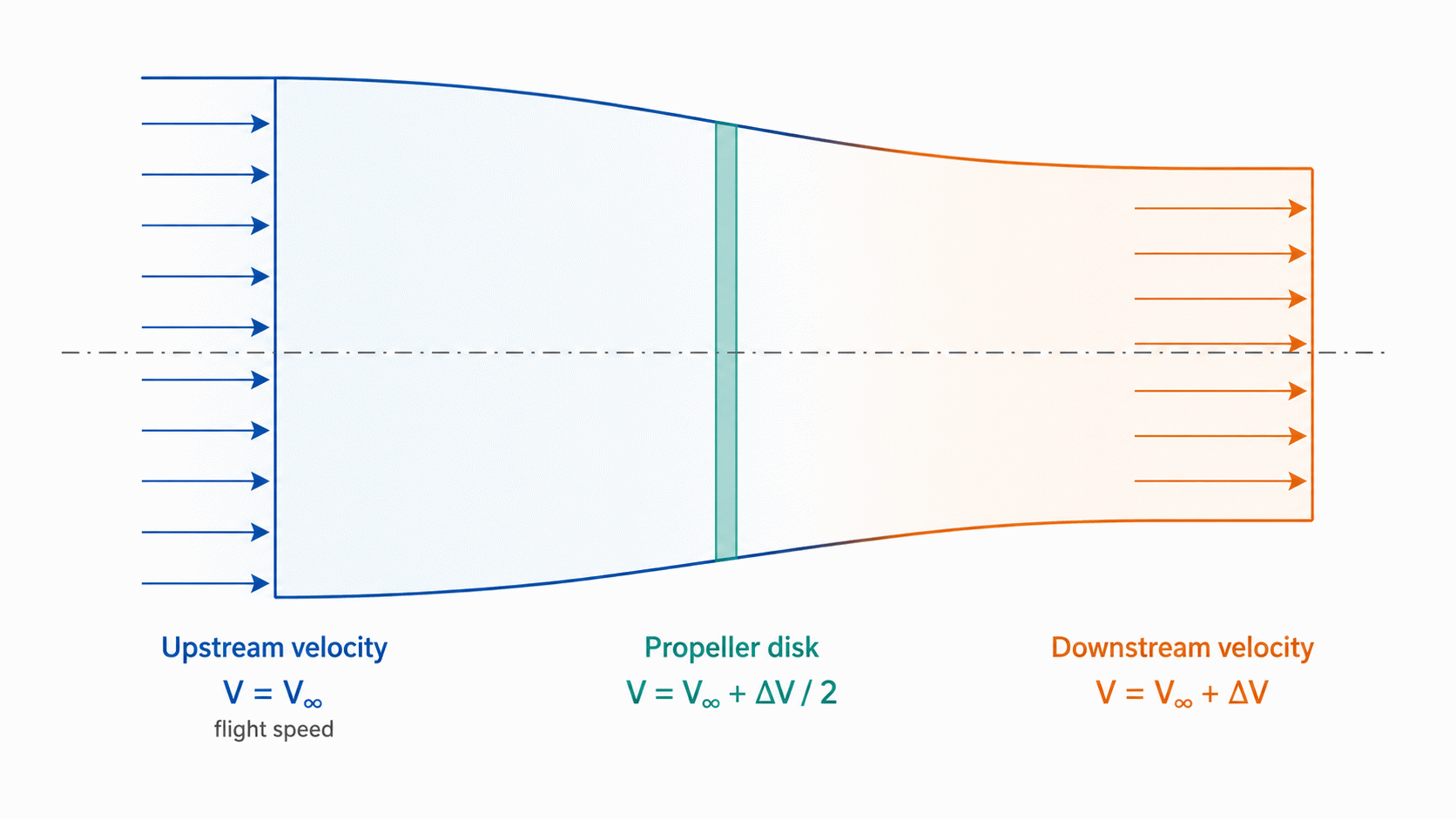
This detail matters, because the mass airflow itself depends on the propeller’s disc area and on the flight speed plus half of that speed increase. In other words, the disc’s diameter directly sets how much air is available to accelerate — and that’s where the story of “efficiency” begins.
The ceiling you can’t design your way around
Two quantities can now be compared:
– the **useful power** actually delivered to the aircraft (thrust × flight speed)
– the **absorbed power** the propeller must draw from the engine to produce that thrust (thrust × the average speed it imparts to the air)
Their ratio is the propeller’s **propulsive efficiency** — and it is an absolute limit, the real design target for a propeller engineer, independent of how well the blades themselves are shaped.
This is why a small-diameter propeller is structurally disadvantaged: to produce the same thrust through a smaller disc, it must accelerate a smaller mass of air much harder, which increases ΔV and degrades this efficiency ceiling — and the penalty gets worse at low flight speeds. Increasing the number of blades can claw back some of that lost performance, but it can never fully replace the diameter you didn’t have.
Once this ceiling is respected, the propeller designer’s real job becomes making sure nothing pushes performance further below it — starting with the right thrust distribution along the blade, achieved through the right combination of pitch, chord and airfoil at every span position.
The other two enemies: drag
On top of this propulsive-efficiency limit, blades — like any wing — generate drag, in two distinct forms.
**Friction drag** depends on the airfoil’s shape and its operating conditions. The tricky part is that a propeller isn’t a wing: the local speed changes constantly from blade root to tip. At the root, the low local speed and small chord give a poor Reynolds number, so airfoil performance is mediocre. At the tip, the speed is close to the speed of sound: Mach effects degrade airfoil behaviour, and the smallest surface imperfection can trigger local supersonic flow — with an immediate cost in noise and performance.
**Induced drag**, linked to the finite length of the blade, is straightforward to calculate for a wing, where speed is constant along the span. For a propeller blade, where speed varies continuously from root to tip, no ready-made method exists in the literature — E-Props’ engineering team had to develop its own calculation approach, one so demanding that it accounts for the vast majority of the computation time spent modelling the airflow around a blade.
Designing within the limits
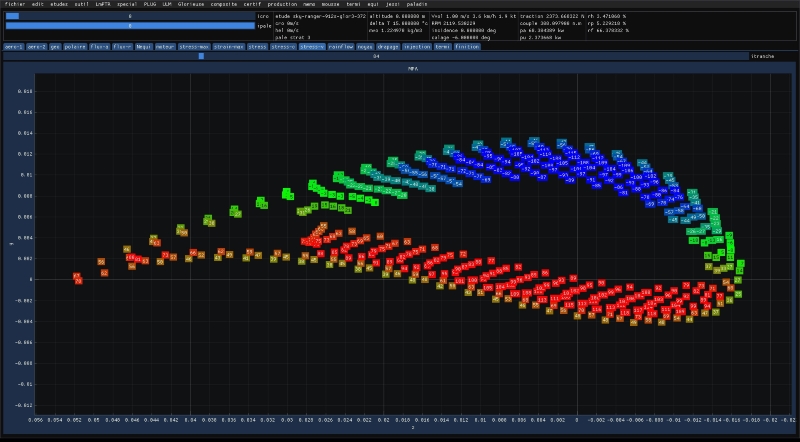
None of these physical limits can be pushed back by a propeller designer. What can be controlled is making sure the propeller doesn’t waste performance *within* them — which is exactly what E-Props’ in-house design software, LUKY, is built to do: exploring thrust distribution, chord, pitch and airfoil choices along the span to get as close as possible to the theoretical efficiency ceiling, for a given diameter, blade count and flight condition.
**The takeaway:** a propeller’s performance is bounded long before its blades are drawn — by its diameter, by the flight speed it operates at, and by unavoidable friction and induced drag. Good propeller design isn’t about beating these limits. It’s about getting as close to them as physics allows.

Post Comment
You must be logged in to post a comment.