
MACH’s Lesson #1: Why Every Gram Counts
Meet MACH the marmot
In aviation, mass is never a detail: it sets the speed below which your aircraft simply stops flying. That is the message of the very first episode of The Lessons of MACH, our new comic strip in which MACH, a goggled marmot wearing the E-Props sash, explains flight mechanics to a classroom of very attentive (and sometimes very hungry) fellow marmots.
In seven panels, MACH goes from “Why does it fly?” to a real formula on the blackboard, survives a student who wants to board with a raclette sandwich, and closes with the motto every pilot should keep in mind: in aviation, every gram counts.
The comic keeps it fun. In this post we take the same path, with the equations written out properly, so you can check every step yourself.

Why does it fly? Lift must balance weight
“Because it has wings, chief!” is not wrong, but MACH wants more: the wings must produce enough lift to support the aircraft’s weight.
First, a word on vocabulary, because it matters. Mass m is the amount of matter, in kilograms. Weight W is the force gravity exerts on that mass, in newtons:
W = m · g (with g ≈ 9.81 m/s²)
A 600 kg aircraft therefore weighs about 600 × 9.81 ≈ 5 886 N. In steady, level flight, lift L must exactly balance that weight:
L = W = m · g
Add mass, and the wings must produce more lift to keep the aircraft in the air.
The faster we go, the more the wings can carry
Lift is given by the classic lift equation:
L = ½ · ρ · V² · S · C_L
where ρ is the air density (kg/m³), V the true airspeed (m/s), S the wing area (m²) and C_L the lift coefficient (dimensionless). In the comic, MACH writes it C_z, the French notation: C_z and C_L are the same thing.
Lift grows with the square of speed, which is exactly what panel 3 says. But the lift coefficient cannot grow forever: as the angle of attack increases, C_L reaches a maximum, C_Lmax, and beyond it the wing stalls. So there is a minimum speed below which the wing can no longer produce enough lift.
Set L = m g and C_L = C_Lmax, then solve for V:
m · g = ½ · ρ · V_min² · S · C_Lmax ⟹ V_min = √( 2 · m · g / (ρ · S · C_Lmax) )
This is the formula on MACH’s blackboard in panel 4. It gives the stall speed in level flight (load factor 1), for a given configuration: flaps, weight and balance, power setting.
Two nuances for the purists.
– First, the formula gives a true airspeed; because ρ appears in it, the stall speed indicated on your airspeed indicator stays roughly constant with altitude, while the true stall speed increases as the air gets thinner.
– Second, in a turn or pull-up with load factor n, the wings must carry n times the weight, so the stall speed becomes V_min × √n: about 1.41 × V_min in a 60° bank turn, where n = 2.
21 % more mass, 10 % more stall speed
For the same aircraft, configuration and atmosphere, ρ, S and C_Lmax do not change. Stall speed then varies with the square root of mass:
V_min,2 / V_min,1 = √( m₂ / m₁ )
With 21 % more mass, m₂ / m₁ = 1.21 and √1.21 = 1.10: the stall speed rises by exactly 10 %, as written in panel 4. For small changes, a handy rule of thumb is that the relative change in stall speed is about half the relative change in mass:
ΔV_min / V_min ≈ ½ · Δm / m
A worked example, with round values for a light aircraft at sea level (ρ = 1.225 kg/m³, S = 12 m², C_Lmax = 1.6):
| Total mass | V_min (m/s) | V_min (km/h) | V_min (kt) |
|---|---|---|---|
| 600 kg | 22.4 | 80.5 | 43.5 |
| 726 kg (+21 %) | 24.6 | 88.6 | 47.8 |
Those few km/h are not abstract.
Stall speed drives approach speed, landing speed and takeoff speed, which are all typically taken as a margin above it. Which brings us to panel 5: yes, you may keep the raclette, but you’d better watch the total mass!
Mass shows up everywhere else too
Stall speed is only the beginning. Here are the other places where mass enters the equations, as first-order approximations.
Takeoff distance. The ground roll is roughly s ≈ V_LOF² / (2a). Liftoff speed squared grows with mass (V_LOF² ∝ m), and for a given thrust the acceleration falls as mass rises (a ∝ 1/m). The result:
s₂ / s₁ ≈ ( m₂ / m₁ )²
10 % more mass means about 21 % more takeoff roll. That matters on a short mountain strip on a hot day.
Rate of climb. Climb rate is the excess power divided by the weight:
V_z = ( P_available − P_required ) / ( m · g )
More mass hurts twice: the denominator grows, and the power required to fly grows too, because induced drag increases with lift, and therefore with weight.
Landing energy. The kinetic energy your brakes must absorb is E = ½ m V². Since approach speed squared also scales with mass, at the same safety margin the energy scales roughly with the square of mass:
E = ½ · m · V² so E is proportional to m²
With the example aircraft above (ρ = 1.225 kg/m³, S = 12 m², C_Lmax = 1.6) and an approach at 1.3 × V_min:
| Total mass | Mass change | Approach speed | Landing energy | Energy change |
|---|---|---|---|---|
| 590 kg | −10 kg | 103.8 km/h | 245 kJ | −3.3 % |
| 600 kg | reference | 104.7 km/h | 254 kJ | — |
| 660 kg | +10 % | 109.8 km/h | 307 kJ | +21.0 % |
| 726 kg | +21 % | 115.2 km/h | 372 kJ | +46.4 % |
Balance. Where the mass sits counts as much as how much there is. The centre of gravity position is the mass-weighted average of every item’s position:
x_CG = Σ ( mᵢ · xᵢ ) / Σ mᵢ
It must stay inside the limits of the flight manual for the whole flight.
Why the propeller is a special case
A kilogram saved on the propeller is worth more than a kilogram saved anywhere else, for three reasons.
It sits at the very front. The propeller has the longest forward arm on the aircraft, so in the x_CG formula above its mass weighs heavily on balance. A lighter propeller moves the centre of gravity aft and can reduce or remove the ballast some aircraft carry to compensate for a heavy nose.
It spins. What matters for a rotating part is not only its mass but its moment of inertia, and mass far from the axis counts with the square of its distance:
I = Σ mᵢ · rᵢ²
Lighter blades mean lower inertia, so the engine spins up and down faster, and the crankshaft or gearbox has less rotating mass to drive and to stop.
It is a gyroscope. When the aircraft pitches or yaws at rate Ω, a propeller turning at rate ω creates a gyroscopic moment:
M_gyro = I · ω · Ω
Lower inertia means a smaller gyroscopic moment, so less load on the engine mount and crankshaft, and less tendency to swing the nose during rotation or pull-up.
Light is right: the mass of E-Props propellers
This is why, at E-Props, every propeller is designed around one idea: as light as possible, without compromising strength. The scale does not lie:
| Propeller | Blades | Mass (blades + hub) |
|---|---|---|
| DURANDAL-3 (complete ground adjustable pitch propeller) | 3 | 2 kg |
| GLORIEUSE-3 (complete in-flight variable pitch propeller) | 3 | 4 kg |
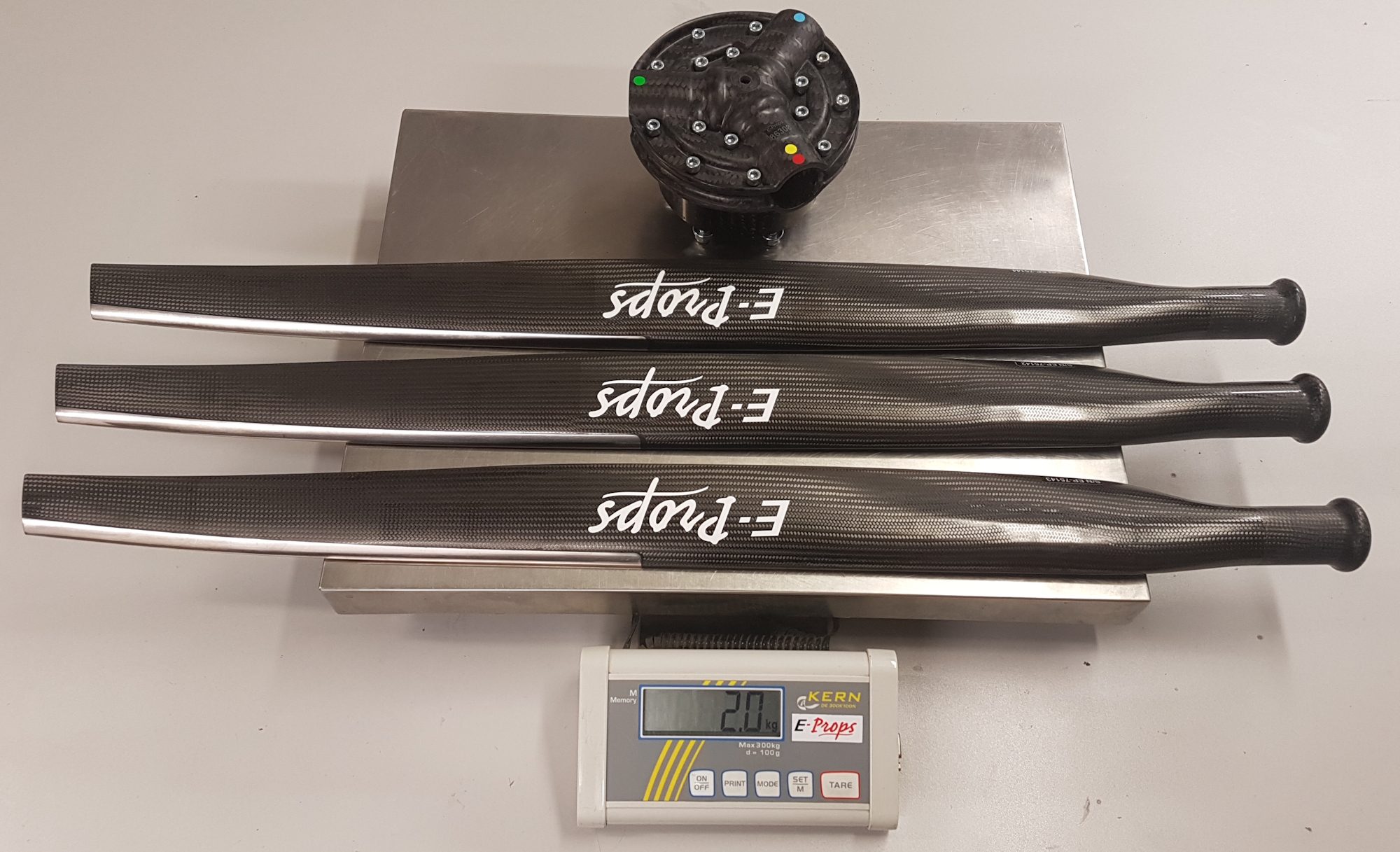
Weigh your current propeller and plug the difference into the formulas above: less stall speed, shorter takeoff, better climb, a CG moved aft and less inertia at the nose.
And as MACH reminds us in panel 6: in aviation, every gram counts. See you soon for the next lesson!




Post Comment
You must be logged in to post a comment.